
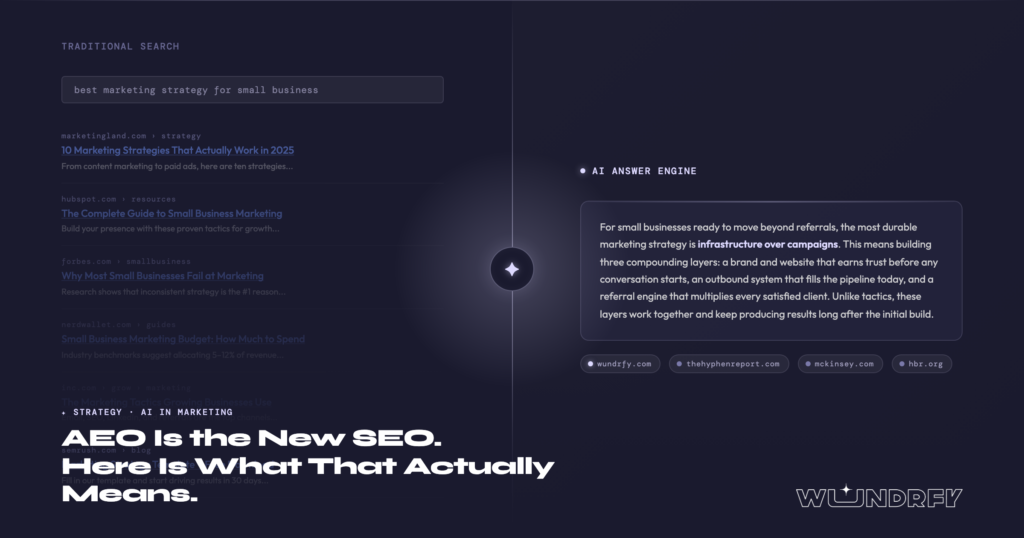
The search bar is splitting in two. If you only know how to show up in one of them, you are already behind.
For twenty years, getting found online meant Google. You learned the rules. You wrote for the algorithm. You watched your blue links climb a results page and called that a marketing win.
Then ChatGPT shipped a search feature. Perplexity raised at a multibillion-dollar valuation on the premise that nobody wants ten blue links anymore. Google rolled out AI Overviews. And on May 19, 2026, Google made it official: the search bar itself, the single most-used input field on the internet, is being completely reimagined around AI. The company called it the biggest change to Search in over 25 years. AI Mode, now powered by Gemini 3.5 Flash, is already past a billion monthly users, with queries more than doubling every quarter since launch. New Information Agents run in the background and surface findings without anyone asking. Gemini, Claude, and a half-dozen other tools answer real questions for real buyers every day, often without sending a single click to anyone’s website.
That is the shift. Search engines retrieve. Answer engines respond. The behavior on the other side of the query is not the same, and the marketing rules that apply to one do not automatically apply to the other.
Answer Engine Optimization, or AEO, is the practice of getting cited, quoted, and referenced inside those generated answers. It is the new shelf space, and right now most businesses are not even on the shelf.
What an answer engine actually does
Type a question into Google: you get a results page. The traditional SEO game.
Type the same question into Perplexity, ChatGPT, or Gemini: the system reads from a curated set of sources, synthesizes a response, and presents it as a single direct answer. Sometimes there are citations. Sometimes there are not. Either way, the user usually does not click through. The answer is the destination.
Three things changed:
- Zero-click is the default. Recent studies show more than half of AI answer queries end without a single outbound click.
- Citations are uneven. Some answer engines cite. Some hide their sources. Some cite them but bury the link three taps deep.
- Your competition is no longer the next page of search results. It is whether you appear inside the answer at all.
If your business does not show up inside the answers a buyer is already getting, you have lost the moment before the buyer ever knew you existed.
Why your existing SEO will not carry you here
This is the part most agencies will not tell their clients, because most agencies are still selling a 2019 SEO playbook with a 2026 invoice attached.
Classic SEO optimizes for crawlers and ranking signals. Keywords. Backlinks. Page authority. Internal linking. The whole machine assumes a human will eventually scan a results page and choose where to click. So you spent a decade making your pages easier to choose.
Answer engines do not need you to be chosen. They need you to be useful inside the response. That is a different optimization target. The signals that matter are different. The structure of your content matters in a different way. And the way the model decides whether to include you, paraphrase you, or quote you is shaped by how clearly your content answers the question without needing the user to click.
Some of the SEO work carries forward. Most of the strategy around it does not.
Search engines retrieve. Answer engines respond. The playbook that worked in one will not carry you in the other.
What AEO actually requires
The work breaks into five honest pieces. None of them are tricks.
1. Be the clearest answer to a real question.
The first paragraph under every heading on your site should answer one question plainly, in language an AI model can quote without distorting it. If your homepage opens with three rotating taglines about your mission, nothing on it is quotable. Headlines should be questions or claims. The text under them should be the answer.
2. Structure for machines, not just for humans.
Schema markup. Clean heading hierarchy. FAQ blocks where they earn their place. Crawlable text instead of text trapped in images or JavaScript. The technical work that used to be a nice-to-have for SEO is now the precondition for being read by anything other than a person scrolling on their phone.
3. Build the entity, not just the page.
Answer engines build a profile of who you are across every mention of your business on the internet. Your website is one input. Your LinkedIn is another. Crunchbase, your reviews, your press, your podcast appearances, your founder bio on a partner site. The more consistent and connected your presence is across those sources, the more confidently a model can talk about you.
4. Earn citations, not just rankings.
The publications and partners that link to you, the podcasts you appear on, the directories that list you, the studies that quote your data. These are the sources answer engines reach for when they need a backup citation. If nobody outside your own website has anything to say about you, the model has nothing to cite. You become invisible by default.
5. Track presence, not just position.
The new metric is not what page do I rank on. It is whether you appear in the answer and what the answer says about you. Tools for this are early but real. The companies winning AEO are testing prompts the same way they used to test keywords.
The work that still matters
None of this replaces the foundational marketing that makes a business actually grow. A model can quote you, cite you, and link to you, and the buyer can still arrive at your website and bounce in nine seconds because your positioning is unclear, your pricing is hidden, and your contact page makes them work to start a conversation.
AEO opens the door. The site, the brand, the offer, and the system on the other side of the door are what convert.
The smart move right now is to build both at once. A site that earns AEO citations because it is structurally clear. A brand that earns mentions because it actually stands for something. A pipeline system that captures the few clicks you do get and turns them into conversations.
That is the entire reason we keep talking about marketing infrastructure instead of marketing tactics. Tactics chase a single channel. Infrastructure compounds across every channel, including the ones the search engines are quietly turning into.
Where this goes next
If you sell to anyone under forty, your buyer is already running questions through an answer engine before they ever visit your site. They are forming impressions of who is credible and who is not, based on which businesses the AI quotes back to them. The companies that built for AEO early will own that impression for years. The ones that did not will spend the next decade trying to break in.
This is not a 2027 problem. This is a 2026 build, and the businesses moving now are the ones that will be quoted by default twelve months from now.
Want to know how your business is showing up in AI answers today?
Run your own name through Perplexity, ChatGPT, and Gemini this week. Look at what they say about you, what they get wrong, and whether you appear at all when a buyer asks about your category.
If the answers do not look the way you want, that is the start of a useful conversation. Start one with us. Thirty minutes, no pitch. We will tell you what to build first.
